import matplotlib.pyplot as pltRing trial
Load the MIR spectra and soil properties of the soil spectroscopy ring trial of Safanelli et al. (2023)
In the ring trial of Safanelli et al. (2023), 20 laboratories scanned the same 70 soil samples, each with its own MIR spectrometer and procedure. 60 samples are KSSL quality-control soils and 10 come from the North American Proficiency Testing (NAPT) program. The authors converted every spectrum to absorbance and resampled it from 650 to 4000 cm⁻¹ at a 2 cm⁻¹ step. The data also hold spectra of 59 of the samples from a Shimadzu instrument, under the name Hokudai.
The data are not public. load_ringtrial reads them from a local folder. The examples on this page read data/ringtrial in the soilspec workspace. nbdev-test skips them unless you run it with --flags rtdata.
rt_path = Path('../../data/ringtrial')Spectra
load_ringtrial
def load_ringtrial(
    path, # Folder of the ring-trial files, searched with its subfolders
    preprocessing:str='raw', # Name of the spectra file to read, such as 'raw' or 'SNV'
)->dict: # `Spectra` of each instrument, keyed by its `organization` name
Load the ring-trial MIR spectra, one Spectra per instrument, with the soil properties as source
load_ringtrial returns a dictionary with one Spectra per instrument, keyed by the laboratory’s organization name, such as KSSL or IAEA_aug2022. The same sample IDs, RT_01 to RT_70, appear in every Spectra. They share one source table: the soil properties of RT_wetchem_soildata.csv, indexed by sample ID. Its source column says whether a sample comes from KSSL or NAPT.
preprocessing selects one of the spectra files of the paper:
raw: absorbance, from 650 to 4000 cm⁻¹. Only this file includesHokudai.BOC,SG1stDer,SNVandSNVplusSG1stDer: baseline offset correction, Savitzky-Golay first derivative, standard normal variate, and SNV then the derivative, from 660 to 3990 cm⁻¹.SST: the 20 test samples of the paper on the 19 instruments other thanKSSL, after spectral space transformation towardsKSSL, from 660 to 3990 cm⁻¹.
load_ringtrial searches path and its subfolders for each file, so the folder can keep the layout in which the files were shared.
rt = load_ringtrial(rt_path)
test_eq(len(rt), 21)
test_eq(rt['IAEA_aug2022'].spectra.shape, (70, 1676))
test_eq(len(rt['Hokudai'].sample_ids), 59)
list(rt)
['Agrocares',
'Argonne',
'CSU_IL',
'ETH_alpha_1',
'ETH_alpha_2',
'ETH_vertex',
'IAEA_aug2022',
'KSSL',
'LandCare',
'Lesotho',
'MSU',
'OSU',
'Rothamsted',
'Scion',
'UGhent',
'UIUC',
'USP',
'UWisc_fine',
'Woodwell_alpha',
'Woodwell_vertex',
'Hokudai']xy reads the targets from source. On the IAEA instrument, 69 samples have both a spectrum and an exchangeable K value. Sample RT_44 has no K value:
X, y, ids = rt['IAEA_aug2022'].xy('potassium_cmolkg')
test_eq(len(ids), 69)
X.shape, y.shape
((69, 1676), (69, 1))Safanelli et al. found that most of the differences between the raw spectra of different instruments are baseline offsets. Here is sample RT_19 on the KSSL Bruker Vertex 70, the IAEA Thermo Nicolet and the Shimadzu:
fig, ax = plt.subplots(figsize=(8, 3))
for org in ('KSSL', 'IAEA_aug2022', 'Hokudai'):
    s = rt[org]
    ax.plot(s.wavenumbers, s.spectra[list(s.sample_ids).index('RT_19')], label=org)
ax.invert_xaxis()
ax.set_xlabel('Wavenumber (cm⁻¹)')
ax.legend();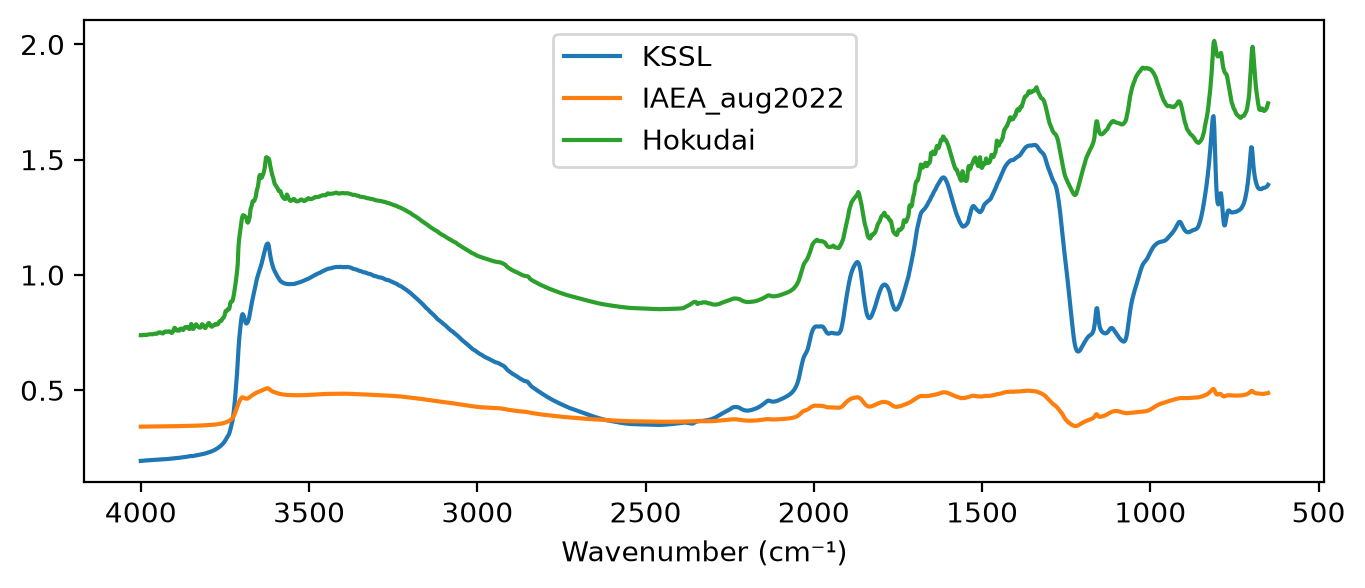
The SST file has no KSSL entry. KSSL is the instrument that the other spectra were transformed towards:
sst = load_ringtrial(rt_path, 'SST')
test_eq(len(sst), 19)
assert 'KSSL' not in sst
sst['IAEA_aug2022'].spectra.shape
(20, 1666)load_ringtrial reads only the six files above. The paper also shared continuum-removed spectra (CR) with missing values, and wavelet coefficients (wavelet). Other names raise a ValueError:
with expect_fail(contains='preprocessing must be one of'): load_ringtrial(rt_path, 'wavelet')